
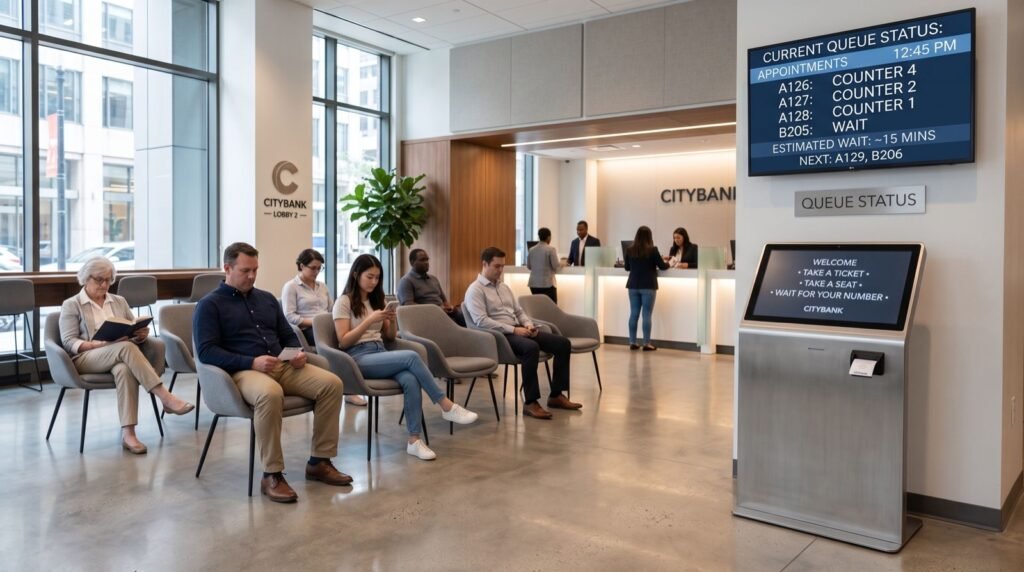
Queue Management System in Karachi: A 2026 Playbook
Karachi runs on volume. From bustling bank branches on Shahrah-e-Faisal to packed passport offices, healthcare centres, and event venues, the city moves millions of people through service points every day. A dependable queue management system in karachi is what separates an organised, trusted operation from a chaotic one that bleeds customers and staff morale. In 2026, with digital adoption accelerating across Pakistan, getting the queue right is a competitive edge, not an afterthought.
This playbook is built for facility managers, event organisers, and service-centre owners in Karachi who need practical answers: what to buy, how to deploy, and how to measure success in a high-footfall environment.
Why Karachi’s Scale Demands a Smarter Queue
Density is the defining challenge. A branch that works fine with 80 daily visitors behaves very differently at 800. Manual token machines buckle under that load, and physical lines spill into walkways, creating safety and reputational risks.
A digital platform absorbs peaks gracefully. It spreads load across counters, lets visitors wait virtually, and gives managers a live view of pressure points. During a large enrolment drive we observed in Karachi, switching from paper tokens to virtual tickets cut visible crowding almost immediately, even though the total number served stayed the same.
What makes queuing in Karachi different from other cities?
Three factors: sheer footfall, wide variation in digital literacy, and frequent power or connectivity interruptions. The best deployments in Karachi therefore combine mobile ticketing for tech-savvy visitors with simple kiosk or staff-assisted check-in for everyone else, plus offline-tolerant hardware that survives outages.
The Building Blocks You Actually Need
It is easy to over-buy. For most Karachi service points, the essential stack is lean and focused.
- Multi-language ticketing — Urdu and English at minimum for accessibility.
- Virtual queue via SMS or QR — critical where app installs are low.
- Large, high-contrast displays — readable across a crowded hall.
- Offline-capable terminals — service continues during brief outages.
- Manager analytics — heat-maps of peak hours and bottlenecks.
Beyond the Counter: Drive-Thru and High-Speed Service
Queuing is not limited to indoor halls. Fast-food chains, pharmacies, and banking kiosks increasingly serve customers in vehicles, where the same principles apply: order accuracy, clear communication, and minimal wait. Operators expanding into the Gulf often benchmark against proven setups like an HME Drive Thru in Riyadh, then adapt that speed-of-service discipline to Karachi’s outlets. The lesson travels well: a tight audio and timing loop keeps cars moving just as a virtual token keeps a lobby calm.
Comparing Check-In Methods for Karachi Venues
Match the method to your audience. The table below summarises the trade-offs.
| Check-in method | Best audience | Strength | Watch-out |
|---|---|---|---|
| QR / mobile | Younger, urban visitors | No queue contact | Needs data / app |
| SMS virtual queue | Broad public | Works on any phone | SMS gateway cost |
| Kiosk ticket | Walk-in crowds | Familiar, fast | Hardware upkeep |
| Staff-assisted | Elderly / low literacy | Inclusive | Labour intensive |
A Deployment Roadmap for High-Footfall Sites
Rolling out in a busy Karachi location rewards careful sequencing. Follow these steps to keep service running while you upgrade.
- Map your peak hours using a week of manual counts.
- Choose a hybrid check-in mix so no visitor is excluded.
- Install offline-tolerant terminals to survive power dips.
- Run a soft launch during a quieter weekday.
- Scale to full footfall only after staff are confident.
One original, field-tested tip: place a greeter near the entrance for the first two weeks. This human bridge teaches visitors the new digital flow far faster than any signage, and it dramatically lowers early resistance. Event organisers who partnered with quality service providers reported the same — a friendly first touchpoint makes the technology feel effortless.
Measuring Success: The Metrics That Matter
Buying the platform is easy; proving it works is what earns budget for the next branch. In a high-footfall Karachi site, focus on a small set of honest numbers rather than a cluttered dashboard.
Average wait time is the headline figure, but do not stop there. Track abandonment — the share of visitors who take a ticket and leave before being served — because it exposes hidden frustration that averages hide. A falling abandonment rate is often a stronger signal of success than a slightly shorter average wait.
Service time per counter reveals training gaps and staffing imbalances. If one window consistently takes twice as long, the issue may be process or coaching rather than the customer. Peak-hour heat-maps then tell you exactly when to add staff, so you schedule around real demand instead of guesswork.
From experience with busy enrolment centres, the organisations that review these four metrics every single week improve fastest. They spot a Ramadan surge or a payday rush before it overwhelms the hall, and they redeploy staff calmly instead of reacting to a crisis. Data turns a chaotic lobby into a predictable, manageable operation.
Reliability, Accessibility, and Standards
A queue system in Karachi must be inclusive and dependable. Designing displays and kiosks against recognised accessibility guidance such as the W3C WCAG accessibility guidelines ensures visitors with low vision or limited mobility can still use your service confidently. Combine that with uninterruptible power and a local support contract, and your platform will hold up under the city’s real-world demands.
Frequently Asked Questions
How quickly can a queue management system in Karachi go live?
A single high-footfall site can be operational within days for basic ticketing, though a hybrid rollout with SMS, kiosks, and staff training usually spans two to four weeks for a smooth transition.
Does it work during power or internet outages?
The right hardware does. Look for offline-tolerant terminals and battery backup so ticketing continues locally and syncs once connectivity returns — essential in Karachi conditions.
Can the same platform handle both indoor queues and drive-thru service?
Yes. Leading vendors offer modules for lobbies and vehicle lanes, letting you standardise timing, communication, and reporting across both channels.
Is multi-language support really necessary?
For Karachi, yes. Offering Urdu and English at minimum improves accessibility, reduces staff questions, and makes the system usable across the city’s diverse visitor base.
Conclusion
A well-planned queue management system in Karachi tames the city’s biggest operational challenge — scale — while lifting trust, safety, and staff morale. Prioritise a hybrid check-in mix, offline-ready hardware, and inclusive design, then let live analytics fine-tune your peaks. Whether you run a bank hall, a hospital, or a busy event venue, 2026 is the year to make waiting work for you rather than against you. Speak to an experienced local integrator before your next high-traffic season.